The business coaching market is growing rapidly, and the best part is that it is showing no sign of slowing down! The global business coaching market was approximately USD 1.53 billion in 2025, anticipated to increase to around USD 1.65 billion in 2026.
On top of that, this market is projected to reach nearly USD 2.93 billion by 2034, with a growth of 7.6% from 2025 to 2034.
Of course, that is fueled by increasing demand for leadership growth, strategic guidance, and executive performance improvement. That is, for sure, great news for anyone who is thinking about becoming a business coach.
But let’s be honest here. Creating a profitable business coaching is not just plug and play. You may have passion or years of experience, but turning that into a six-figure coaching business takes strategy and the right roadmap.
If you follow the right steps and learn how to attract clients consistently, you can create a thriving coaching practice and reach that six-figure income goal. Let’s learn in detail in this comprehensive guide.
What Is a Business Coach and What Do They Do?
A business coach is a professional mentor who supports and motivates business owners. They provide expert recommendations for vision, goals, and growth of a company.
Unlike the business consultant who tells the businesses what to do, or a mentor who shares their path, a business coach helps you to find the best solution.
He motivates you but also implements and prioritizes strategies to help your business grow.
As for the core responsibilities of a business coach, it includes
He guides clients with thoughtful questions so they understand the goals, challenges, and hidden gaps.
He helps businesses to set bold yet realistic goals. He also stays accountable for consistent action.
He supports clients in creating clear and practical strategies to solve problems and grow.
He helps to find out and challenge limiting thoughts like fear or doubt, and imposter syndrome.
He assists in improving performance by strengthening leadership, decisions, teamwork, and daily efficiency.
He shares honest and unbiased feedback to bring clarity to complex situations.
He builds confidence and resilience by helping clients learn from setbacks and keep moving forward.
- Nathan Brunner, CEO of Switzerland-based Salarship. |
Right now, more entrepreneurs and leaders are paying for expert guidance than ever before.
That clearly means a massive opportunity for coaches who know how to position themselves and market the right services.
What it Takes to Become a Business Coach?
According to insights shared in Forbes, building a successful business coaching practice depends less on credentials and more on mindsets, structure, and consistent execution.
There are four characteristics a new business coach needs to be successful. They are
A strong mindset
A willingness to follow a plan
Ability to take imperfect action and adjust going forward
A willingness to commit to the process
Authenticity also plays an important role in effective coaching. The personality, value, and approach of a coach naturally shape his coaching style.
A successful coach focuses on bringing real value into every business relationship. The draw inspiration from proven leadership teaching and apply them in practical ways.
An effective coaching model relies on having a systematic plan for guiding business owners toward success.
It started with two critical questions: “How am I going to add value, and where am I going to spend my time to build solid relationships?” The money will follow.
As explained by Karl Diffenderfer, who provides coaching through his company, Higher Impact, “We don’t look for academic credentials. They should have business experience in starting, building, running, and selling businesses.
Their experience should speak to their ability to show you how to be successful in your life and business. We ask, ‘Can this person successfully create the results you are after in your life?’”
Moreover, a successful business coach has the following qualities.
Curiosity
Powerful questions
Real-life Experience
Teachable
Leadership Power
Accountability
Drive
Ability to Reflect
Action
Ability to Listen
Self-awareness
Values
See how to become a great mentor while improving your leadership power here in this TED Talk:
How to Know If Business Coaching Is Right for You?
Actually, business coaching suits people who like helping others think clearly and move forward.
You should feel comfortable listening deeply and asking challenging questions. You will need to guide your clients through uncertainty with patience and empathy.
On top of that, you should have the ability to hold people accountable without judgment. Effective coaches challenge assumptions. They encourage action and support growth.
You also need to feel comfortable with confidence and emotional intelligence. Business owners often face unclear situations. Here, your role is to help them find clarity, not quick answers.
How to Become a Business Coach That Clients Want to Hire You and Build a 6-Figure Practice

According to research, 70% of business coaching clients report improved productivity, and 80% seeing better performance after coaching.
It clearly highlights the increasing demand for skilled coaches, making it possible to become a coach clients want to hire and build a six-figure practice.
Let’s learn how to become that one.
Step 1: Pick Your Niche and Coaching Model
You know, trying to coach everyone often leaves you coaching no one. To attract the right clients, you will need to choose a clear niche so they understand exactly what you offer.
Your choice of niche and coaching model makes the foundation for building a business that clients trust.
First off, you need to validate your niche. Before commiting ensure there is a real demand for your niche.
You can validate your niche through these practical steps.
First, list five problems you have actually solved.
You should use Google Trends or Ahrefs to check for at least 1,000 searches per month.
Scan LinkedIn to confirm fewer than 500 specialists exist in that niche.
Have five brief validation calls asking, “What is your biggest hurdle in that area?”
The following are some hot and growing niches in recent years that you can explore to validate.
Niche | Why It’s Growing | Ideal Client | Entry Price |
AI For SMBs | Almost 70% small businesses are behind on automation AI adoption is increasing 40% YoY. | Founders of companies earning $500K–$2M who lack tech expertise | $4K rollout over 3 months |
Sustainable Scaling | Rising ESG requirements and growing consumer preference for eco-friendly businesses | Growth-stage e-commerce brands with sustainability goals | $5K retainer for audits and strategy |
Remote Leadership | Hybrid work is here to stay 60% of managers lack training | Managers and leaders in the tech or agency sectors | $3.5K cohort program |
Sales Optimization | B2B closing rates remain low at 20%; AI-driven sales tools are expanding rapidly | SaaS executives experiencing growth plateaus | $6K funnel rebuilds |
Now, after selecting the right niche, you will need to choose the right business model that allows you to scale to scale six figures. However, there isn’t a single path to a six-figure coaching business.
Some coaches start with a few one-on-one clients, others run group programs, and some launch digital courses right away.
Your approach should suit your skills, energy, and interests, rather than mimicking someone else.
Here, let’s get to know some popular coaching business models.
I) Premium 1:1 Coaching
This model offers deep and personalized support. It has high earnings but limited scalability.
II) Group Programs
It focuses on teaching frameworks and fostering peer discussions. It is more scalable but requires managing group dynamics.
III) Membership or Community Models
You can ensure recurring revenue with accountability built in. However, churn can be a challenge.
IV) Courses or Digital Products
It is easily scalable if your process can be broken into clear steps. It requires steady lead flow.
V) Hybrid Models
It combines the above approaches. Many coaches balance private clients, groups, and digital products for flexibility and scale.
Hitting six figures as a business coach isn’t about luck. It’s about planning the right setup.
For example, a 1:1 specialist working with 10 clients at $1,000 per month can earn $120K per year, and a group program coach running four launches with 15 clients paying $2,000 each also makes $120K annually.
These are not fixed rules. They are examples to help you envision what is achievable.
Identify Your Coaching Archetype
Not every business coach works in the same way. Some business coaches focus on strategy, while others focus on details.
If you think there is one perfect coach, it can make you blend in with the countless LinkedIn bios.
That is why you need to identify your coaching archetypes. They are reflections, not rules.
They reveal how you naturally work with clients and why certain clients resonate with your style while others don’t.
There are many ways to coach, but eight archetypes stand out. Here they are:
Archetype | What You Do | Best Client Fit | First Step |
Reliable Retainer | Provides steady improvements, like monthly KPI reviews | SaaS or retail businesses needing consistent growth | Offer $2K/month for 4 check-ins plus 1 audit |
Cheerleader | Motivates clients and drives accountability | Burned-out agencies or sales teams | Assign one weekly action via Trello |
Problem Solver | Fixes specific issues using deep analysis | Stalled launches or broken funnels | Map issues in a 2-hour session and propose 3 solutions |
Forecaster (Occult Seer) | Predicts trends using intuition and pattern recognition | Fintech or retail companies facing market shifts | Run a 90-minute trend workshop, charge $1.5K |
Forecaster (Devil’s Advocate) | Stress-test plans by identifying risks | Startups preparing for pivots or investments | Deliver a 5-risk report for $2K |
Idea Generator | Brainstorms new revenue streams or strategies | E-commerce or startups exploring diversification | Lead a 90-minute idea sprint and prototype 1 idea |
Second-Opinion Diagnostician | Audits big decisions to uncover blind spots | Pre-merger businesses or executives | Write a 5-point audit report, charge $2.5K |
McGoozler | Nudges clients to “aha” moments subtly | Ego-driven founders needing gentle guidance | Mirror language in calls to gain buy-in |
Step 2: Define Your Ideal Client
In business coaching, personas act as a GPS that guides you in every decision in your coaching business.
A well-defined client persona helps you understand who your ideal client is, what they truly want, and what challenges keep them awake at night.
If you do not have this clarity, even your best coaching offer may miss the mark.
Here is an example of an ideal client persona.
Age: 30–45
Revenue: Around $750K per year
Psychographics: Ambitious and motivated but often overwhelmed
Core Pain Point: Losing up to 30% of leads due to inefficient or broken sales funnels
This persona highlights the demographic as well as mindset, struggles, and priorities. They are essential to customize your coaching approach according to your client's needs.
To create your client's persona that truly reflects reality, you need to look beyond assumptions. You will need to observe the actual behavior of your clients.
To do so, you can expend time exploring online communities like Reddit’s r/smallbusiness to see the real challenges and questions your potential clients are facing.
You can also run polls on LinkedIn within your niche to get a sense of their priorities, pain points, and goals.
Avoid generic profiles or trying to target “everyone,” because a broad approach dilutes your message and can cut your conversion rates in half.
The more specific you get, the easier it becomes to attract clients who truly value your expertise.
Taking this step seriously lays a solid foundation for a coaching business that connects deeply with clients and converts consistently.
Step 3: Develop Your Signature Coaching Framework
For sure, clients just do not buy random advice. Instead, they buy transformation. Your clients will need a clear and repeatable process to feel confident in your coaching.
That is why your business coaching framework matters. A solid coaching methodology gives clients confidence in your process.
It provides your business with a roadmap for each engagement and shows your expertise in action.
It also makes your coaching easier to deliver consistently, whether you are working one-on-one or with groups.
Here, platforms like EzyCourse can help you build and deliver this framework in a structured and professional way that supports both learning and client results.

With its coaching programs feature, you can:
Create structured coaching journeys with lessons, tasks, exercises, and trackers built right into the platform.
Monitor client progress with built-in trackers, helping both you and your clients measure growth and stay accountable.
Host your entire coaching experience in one place, reducing friction and improving the learning experience.
This makes it easier to map your process from start to finish, without relying on multiple disconnected tools.
Build a Collaborative Coaching Approach
Without dictating answers, effective business coaching is about creating a collaborative environment where clients feel safe to explore challenges and move forward with clarity.
The most successful coaching framework balances listening with leadership.
A proven coaching framework structure looks like the following
60% discovery where clients will talk through their goals, obstacles, and thought patterns.
40% structured expertise where you introduce framework, tools, and practical next steps.
This balance helps the clients to feel heard while getting benefits from your experience.
Building your framework

To build your business coaching framework, start by outlining the consistent steps you follow with each client, no matter their niche. It creates a clear structure that builds trust and sets expectations.
I) Discovery and assessment
First, you will need to dive deep into the current situation of your client, their challenges, and opportunities. This stage helps you understand their goals and what might be holding them back.
II) Goal setting
Next, you have to work with clients to set specific and achievable objectives. These goals provide directions and create motivation for consistent progress.
III) Strategy and exploration
Brainstorm the solutions and explore different paths to achieve the objectives of your clients.
It encourages creativity while keeping a practical focus.
IV) Implementation and support
Now, in this stage, you will need to guide your client as they take actions, offering resources and accountability.
This type of implementation and support ensures that plans translate into measurable outcomes.
V) Review and measurement
After that, regularly track progress and assess results. You should also refine your strategies as you need it. It will ensure continuous improvement and validate the effectiveness of your coaching.
Step 4: Get Certified (Only If It Adds Credibility)

When it comes to business coaching, certification often becomes a hot topic. Well, do you need one to become successful?
Actually, the truth is it depends on your niche, target clients, and experience. Certifications can provide you credibility and structure for sure; however, it is not a guaranteed shortcut to building a successful practice.
It also has some good and bad sides as well. Talking about the benefits, certification programs teach specific approaches and methodologies to accomplish tasks effectively.
They ensure the coaches understand what, why, and how to apply their skills. On top of that, it also offers many other benefits. Such as,
Certification adds trust and credibility
You can get structured learning as a business coach
Develop and sharpen your skills
You can access community support
Certified coaches are often perceived as more valuable by clients and get higher fees.
However, certifications alone do not guarantee you effective coaching.
A newly certified business coach may understand the what and how. But they may lack the when and context to apply it effectively. Experience still matters.
On top of that, the cost of quality certifications is also higher, often ranging from $3000 to $15000+.
So, if you already have a strong track record in your niche, practical experience, and measurable results can be more compelling than certifications.
In some cases, certification of the course makes sense. Like:
You have limited business leadership experience.
You plan to coach executives or work in corporate environments.
You want structured learning and credibility early in your coaching journey.
You value belonging to a global professional body like ICF.
If you choose certifications, look for business coaching certifications accredited by reputable organizations.
Such as:
International Coaching Federation (ICF)
Center for Credentialing & Education (CCE)
These bodies ensure that their affiliated programs meet high standards of quality.
You can have confidence in the credibility and value of the training you will receive by choosing a certification program from an accredited organization.
Experts suggest considering combining different, relevant credentials.
For example…
Certification Type | Focus Area | Why It Helps |
Project Management Professional (PMP) | Structured project planning | It ensures systematic coaching of business processes |
Agile Certification | Flexible problem-solving | It helps adapt frameworks for different client needs |
Lean Six Sigma | Process improvement | It strengthens efficiency and measurable results |
Change Management & Organizational Behavior | People and process alignment | It supports leadership and team-focused coaching |
Coaches with multiple complementary certifications bring a broader toolkit. They can also offer clients practical solutions from different perspectives.
Step 5: Set Value-Based Pricing and Packages
When you want to build a 6-figure business coaching, it is crucial to set intentional and value-based pricing instead of just guessing.
It is seen that many coaches undervalue their expertise due to imposter syndrome or fear of rejection.
But speaking the truth, pricing strategically is one of the biggest levers to reach six figures in business coaching.
A simple rule of thumb is that if your coaching unlocks $100k in value for a client, you should consider charging 10% of that.
To set strategic pricing for your business, first, you need to identify your financial goal and work backward.
For example, if your annual target is $150,000 and you plan to work 40 weeks per year, your weekly income goal is $3,750.
There are multiple ways to reach that goal. For instance,
Ten private clients at $375 per week
Five clients at $750 per week, or
A group program of 12 people at $2,000 each, generating $24,000 per launch.
That means you need to understand how your pricing contributes to your yearly goal before setting rates.
You can research your market, but lead with value. You will need to understand what other charge.
But you should not set your prices at the lowest point. You should price according to the outcomes you deliver to your clients.
As mentioned by BJ O’Neal, who promotes his business through his Business Coach Mastery podcast, “You must convince prospects that you are the guide in helping them solve their problems. Often, we start by reviewing costs.
That’s because each dollar saved increases profit immediately. We work on the premise that revenue feeds the ego, but profit feeds the family. It’s also a simpler process, since increasing sales is generally a more involved process.”
You can also consider offering packages to maximize your earnings and client commitment.
If you offer hourly-based pricing, it can limit your earning potential and can make it hard to keep clients engaged in the long term.
Here, packages can create stability and commitments. For example, a $3,000 three-month package is essentially $250 per session for 12 sessions.
It provides you with a predictable income and structured support for your client.
The following is an example of a package of business coaching for your understanding.
Package | Duration & Structure | Price | Target Result |
Starter Intensive | 3 months, bi-weekly calls + audit | $3K to $5K | 20% revenue lift or 15% churn drop |
Growth Retainer | 6 months, weekly syncs + workshop | $8K to $12K | Scaled operations, hire-ready systems |
Elite Cohort | 4 months, group + 1:1 coaching | $6K per person | 50% average goal achievement |
Step 6: Get Your First Client from Your Network
Now, when you start as a business coach, you should not start cold. Instead, you should start close. Your network can be your first source of clients.
A highly effective strategy is the “Three for Free” offer. Here, you coach three clients for four weeks in exchange for testimonials and referrals.
You can aim for roughly 30% of these clients to roll into paying engagements.
Here’s an example message you can use:
“Hi [Name], I saw your post about ad fatigue. It sounds challenging! I’ve helped DTC brands improve ROAS by 25%. Would you like a free 20-minute audit to spot any issues?”
This message shows you’re helpful and trustworthy, and it lets potential clients try your coaching without any risk.
Here is how you can get started.
Mine your network by pulling 50 LinkedIn contacts using the “Connections” filter and prioritizing people in your niche.
Send targeted DMs reaching out to 10 contacts per day, five days a week. You should keep messages short, specific, and focused on pain points.
Launch “Three for Free”. You can deliver two calls, one audit, and one action plan per client.
You should also follow up strategically. Check in after three days with a message like, “Hey [Name], circling back. Still battling those ad costs?” Limit follow-ups to two.
Benchmarks to Track
Reply rate: 20%
Call bookings: 5%
Goal: 3–5 consults within two weeks, and at least one paid client within 30 days
Step 7: Build Your Website and Personal Brand

Your website is often the first place where your clients judge your credibility. You should keep your website clean and professional. It should not be overloaded with fluff.
On your website, testimonials are your proof. However, you should wait until you have at least two or three solid ones from step 6 before building.
How to build your website?
For an easy and no-code approach, you can use platforms like EzyCourse, Squarespace ($16 per month), or Carrd ($19 per year).
Then choose a clean template that works for great visuals. Now make sure your website includes these essential pages.
Hero Section
Feature a single and powerful line with proof: “Scaled SaaS from $500K to $2M in 9 Months.” Add a professional headshot and a clear CTA, like “Book a Free Audit.”
Services
Present 2–3 packages. For example, “3-Month Revenue Sprint: $4K,” with a short outcome for each: “Cut churn by 20%.”
Case Studies
Highlight 2–3 successes. Such as “Helped DTC Brand Boost ROAS 30%,” using a quote along with a 100-word story for context.
Lead Magnet
You can provide a free resource like “5 AI Hacks for E-com Growth” (PDF via Canva) and link it to a Google Form to capture emails.
For SEO, you should use target-specific niche keywords. Such as “AI coaching for ecommerce” or “SaaS growth coach.”
As for branding, go bold with colors like navy or neon green. Moreover, use clean and sans-serif fonts with A punchy tagline, like “From Stuck to Stacked—Your Growth, Unlocked,” works well.
You can also connect content to your site by adding a webinar signup. For instance, “Join my free Scaling 101 webinar.”
👉 Build Your Business Coaching Website Now!🔥
Step 8: Launch a Simple Sales and Discovery Process
Now that you have your clients, a clear framework, and a professional website, it is time to scale your coaching business.
You know, scaling your business does not mean getting more clients. It is all about creating systems, structuring your services, and using technology to deliver consistent results.
First, you need to streamline how you work with clients, document processes, and use project management tools to save time.
Then you have to package your coaching into clear programs or tiers. Like “3-Month Business Acceleration Intensive,” “6-Month Leadership Mastery Program,” or “Year-Long Scaling Partnership.”
You have to be clear about the duration, key outcome, what is included, and what investment it will require.
The sales funnel
As for the sales funnel, you can start by creating awareness through content, social media, and networking to attract prospects.
You can capture leads with a valuable freebie and get them on your email list. consistently provide helpful content via email or social media.
It will help to build trust and credibility. Then introduce your coaching program clearly through your website, emails, and webinars.
Now the critical conversion step is the discovery or strategy call.
Mastering the discovery call
The goal of this call is to see if there is a strong mutual fit. Can you truly help your clients to achieve their goals? Are they ready and able to invest?
Here is an example structure.
Build rapport - 5 mins
Understand their situation and goals - deep dive – 15 to 20 mins
Explore challenges and their impact - 10 mins
Discuss potential solutions and your approach - 5 to 10 mins
Present your offer and investment - 5 mins
Handle objections and discuss next steps - 5 mins
How Much Can Career Coaches Earn?
Career coaches can earn, on average, $100,145 per year. However, as business coaching is a diverse field, the income can vary substantially within this occupation.
Professional business coaches set a target range and goal coachs’ earning between $10,000 to $30,000 per month.
As for one-on-one coaching, the monthly earnings can range between $1,000 and $5,000 per client, per month. Here, the average is more than $2,000 to $2,500.
However, experts claim that high-performing business coaches can earn as much as $5,000 - $10,000 per client, per month.
If you are a beginner, you can charge between $1,000 and $1,500 per client, per month, until you gain more experience and create a pattern of referrals.
Tips for Building A 6-Figure Practice In Business Coaching
Now that you have started your career as a business coach, turning your expertise into a six-figure practice is not luck. It is all about strategy!
With the right approach and client-focused methods, you can grow a profitable business. Here are some proven tips.
I) Structuring Your Service Offerings
To hit six figures, you will need more than a single service. You should create a tiered service structure that gives clients options at different price points and commitment levels.
You can start with entry-level products like downloadable guides or short digital courses.
Then offer mid-tier group programs that let you serve more people with less time per client.
Finally, include premium 1:1 coaching, where you work deeply with fewer clients for higher fees.
II) Offer Free Sessions Or Beta Programs
Free sessions and beta programs are powerful ways to attract your first clients and build early momentum.
A discovery call or beta offer lets people experience your coaching firsthand and understand your value.
It can also make an easy decision to commit and give you valuable feedback. You can refine your programs based on your client responses and use the testimonials you collect to build trust with future prospects.
III) Share Your Wins
When you share your success stories, it enhances your credibility and confidence in your practice.
It helps your potential clients to see how you are achieving real results for your clients. It builds trust and shows your expertise. Then they are more likely to buy your coaching.
Use testimonials, case studies, and outcome highlights on your website, email newsletters, and social channels.
You can also include specific details like measurable outcomes. For example, a client who doubled their income or landed a major promotion — to make your wins even more compelling.
IV) Build Your Online Presence
You should always keep in mind that your digital presence is your foundation. You can start with your website that clearly explains your coaching services, pricing, and how clients can book sessions.
On social media, focus on platforms where your ideal clients spend time, like Instagram, LinkedIn, or Facebook.
You should consistently share valuable tips, behind-the-scenes content, and personal insights.
This combination attracts more clients and helps to build a 6-figure business coaching.
V) Leverage Technology and Platforms
Technology can also help you scale your business to 6 figure without burning out. You can use automation tools to simplify scheduling, payment processing, and email marketing.
Here, platforms like EzyCourse help you build funnels that bring in leads, make more business relationships, and convert them into paying clients.
You can also create automated courses or membership portals that generate revenue when you are not actively coaching.
The right technology saves time and lets you focus on growth instead of admin tasks.
Proven Habits to Build a 6-Figure Coaching Business
Now let’s talk about 4 habits that every six-figure coach follows so that you can also build a business that pays you well, as well as gives you freedom.
Habit 1: 6-Figure Coaches Treat Their Coaching Like a Business
First off, successful coaches treat their coaching like a business, not a hobby. Here, you have to wear two hats.
One is the CEO hat, and the other is the employee hat. You have to play both roles, where your CEO role will be visionary and your employee role executive.
You have to set work hours, make clear goals, and follow them.
Habit 2: 6-Figure Coaches Use Their Time Like a Weapon
You know, 6-figure coaches do not stay busy for the sake of being busy. They are actually intentional with their time.
They only focus on what truly matters. They protect their best hours, avoid distractions, and delegate tasks that don’t need their personal attention.
Their every action is intentional. It makes time a powerful tool to grow their business faster.
Habit 3: 6-Figure Coaches Master One Offer Before Making More
Successful coaches focus on perfecting one coaching program or service. They do not rush to create a new one.
They listen to clients, validate what works, and ensure it sells continuously. Once that one offer succeeds, they take on more programs. It prevents wasted efforts and builds a strong foundation to earn more.
Habit 4: 6-Figure Coaches Sell with Confidence
In business coaching, confidence truly matters. Confidence builds trust among your clients. Your belief makes your clients believe that you can bring results.
Successful coaches know their offer works and communicate its value clearly. They are honest about what clients can expect and who it’s for.
Become A Business Coach With Ezycourse
By now, you must have a clear understanding of the steps of how to become a business coach and how to scale the business to six figure. All is just left to put your plan into action.
A few more things. Before you launch your coaching, ensure your business has a proper legal structure like LLC. You can also consult a trusted professional if needed.
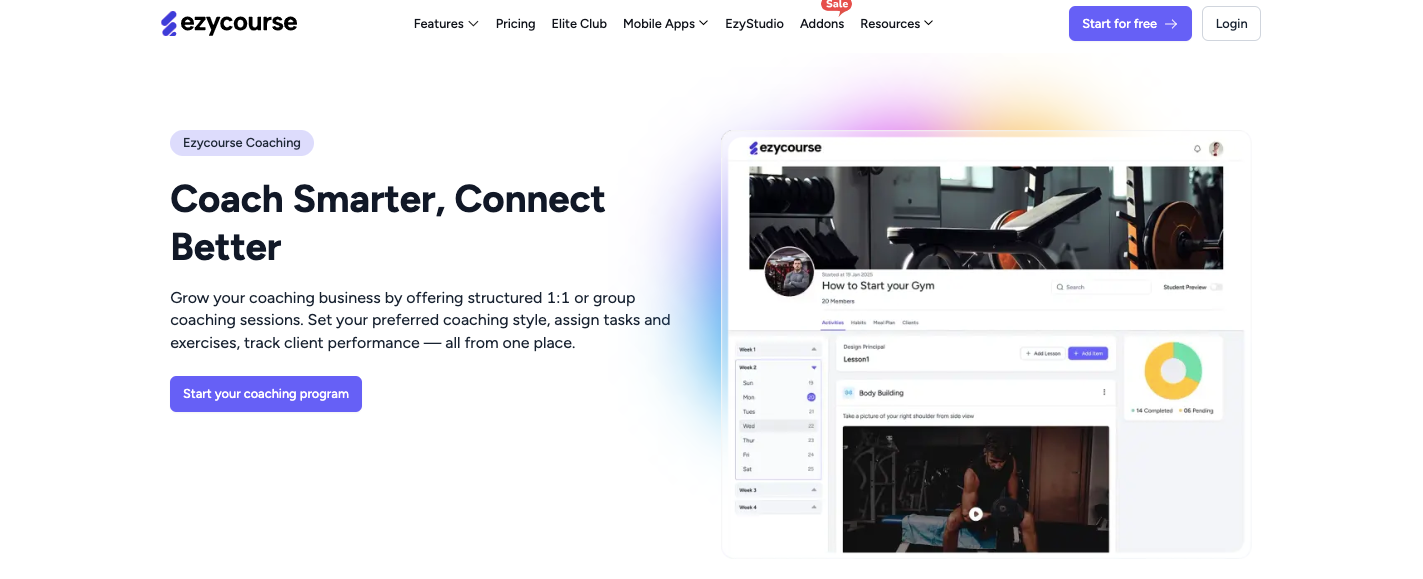
You can also make this coaching creation program easier with EzyCourse. With this efficient platform, you can create structured coaching programs, host 1:1 or group sessions, and build digital courses.
The platform helps you manage memberships and track client progress. You can also get marketing tools like landing pages, email campaigns, and analytics. These tools make it easier to attract clients and grow your revenue.
So, start building your business coaching program with EzyCourse efficiently whenever you are ready!
👉 Build Your Coaching Platform Now!🔥
Frequently Asked Questions
Now, let us try to answer some of your common queries through the questions that are mostly asked by people about business coaching and 6-figure practice.
Do you need a business coach certification?
Frankly speaking, certifications are not required to become a business coach. However, they can help you to enhance your credibility and show your expertise in this field. There are also many coaches who have started their successful coaching with expertise and strong client testimonials.
Can you become a business coach with no experience?
Yes, of course. Even with no prior experience, you can still become a business coach. However, you will need to focus on learning and offering value through research or mentorship. When you gain results, it will help you build credibility.
What type of coach makes the most money?
Generally, the business coaches who support executive, leadership, and high-performance businesses generally earn more. They work with corporations and top executives, offering high-priced packages. They often generate six-figure or even seven-figure annual income.
Wrapping Up
Well, as you see, business coaching is all in all a rewarding and highly profitable business. If you want to be successful in a thing business with a 6-figure practice, you will need a strategy and continuous execution.
Here, platforms like EzyCourse make your journey easier by helping you create a structured coaching framework and track client progress. In short, just by combining your expertise with the right tools, you can create and scale your coaching business efficiently toward six figures.